Monday, September 30, 2013

Litengård welcomes three new Icelandic ewes!

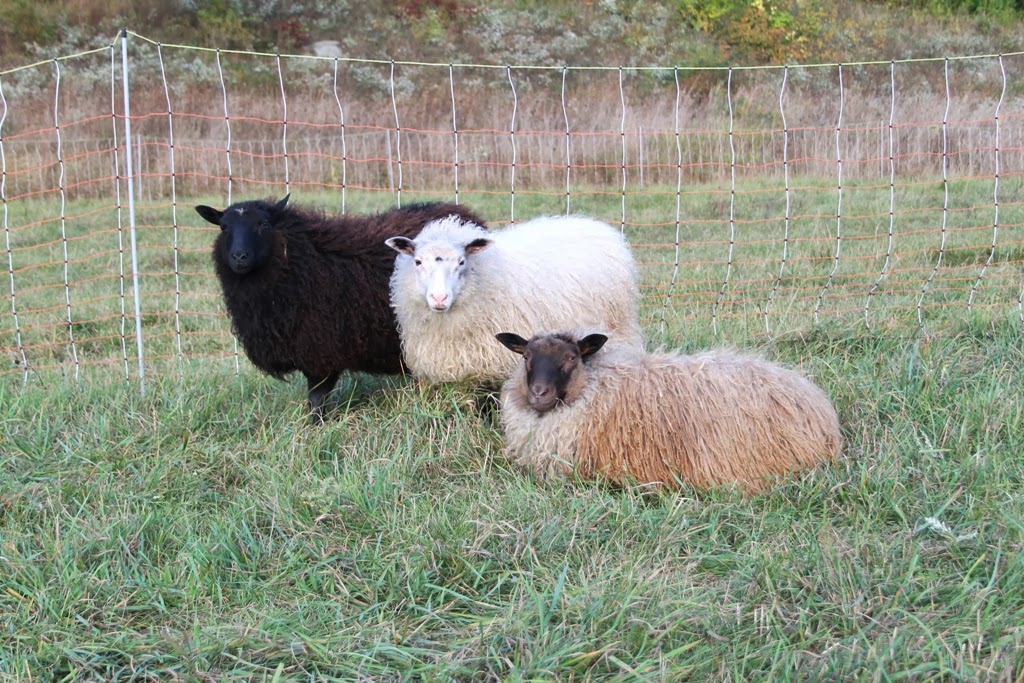
At long last, the start of our permanent ewe flock has begun, the arrival three beautiful Icelandic ewe lambs from Whippoorwill Farm in Iron River, WI.

Until now I've only been dreaming of starting our own ewe flock and practicing sheep care with our Amish market lambs

Last year this entailed trimming hooves, treating hoof rot, trimming hooves, treating diarrhea, trimming hooves, treating pink eye, and trimming hooves.

This season we've had nary a problem with our ram lambs except that they are now getting a bit "rammy" and I have to watch my knees when I'm in their paddock.

{They weren't supposed to get rammy this year... they're all... well... wethers...}

Icelandic ewes of Litengård farm

Last winter once the sheep were all gone I spent a fair amount of time researching a variety of sheep breeds, trying to narrow down my "top 10" list to maybe just one or two breeds.

I soon realized most of my favorite breeds had some attributes in common - such as they all tended to be northern European "primitive" breeds, which are basically a breed, usually ancient, that has not been much "improved" by changing the breed to accommodate better meat or wool production. They remain more like they were thousands of years ago. They also all tended to be "landrace" breeds and they all tended to be "short-tailed."

The benefits of these attributes are many - they have survived for thousands of years, usually with minimal management interventions.  The ones that were prone to problems and parasites have died off or been culled.  They tend to be easy-birthers and great mothers.  Their natually short tails mean no tail docking is required, and because of this, ewes will not tend to prolapse (a problem in docked-tail sheep).

"Which way is home?"

In short, they tend to be hardy.  And let me tell you, after spending every weekend treating hoof rot and diarrhea last summer in our mixed-breed meat sheep, having something a little more "hands off" was enticing.

Not only that, but we live in the northern Midwest.  Winters, although seemingly more often peppered with milder days, still tend to be severe.

We don't have a lot of barn space. The critters that overwinter here must have minimal housing needs.  Our alpacas will lounge outside in temps far, far below zero as long as it's not raining.  The sheep must be similarly inclined.

So after deciding I really wanted a northern European, landrace short-tailed sheep, I first settled on the Norwegian Spelsau, but upon investigation discovered they've never been imported into the USA.

{rats}

 However, there are some other closely related breeds that are currently in the USA.

Such as the Icelandic breed.  Not only do the Icelandics meet all of the above attributes, they do so with beautifully, naturally colored fleeces which are dual-coated and grow so fast it is necessary to shear them twice a year.

Their dual coat, consisting of an outer, longer, Tog, is around 27 microns and is fabulous for weaving and rug making and felting. 

The inner coat, the Thel, is shorter and finer, around 20 microns, perfect for making things for "next-to-skin" wear.

The beauty of all of this is that my new wool combs will separate these two coats so that I may use them for separate projects or leave them combined.  When spun together with a light twist a spinner can make a lofty "lopi" yarn.

{say it with me - Lofty Lopi Lofty Lopi Lofty Lopi...}

So the only question that remained was where to purchase our ewes.  After negotiating with a local farm for almost a year and having them back out on us twice, I noticed a posting on Facebook that my first choice farm had decided which ewe lambs they would have available for sale and were taking deposits.

Additionally, their farm was only 40 minutes from Washburn, where we were heading for a weekend of camping with our family.  It would be easy to pick the ewes up on our way home that weekend.

I thought we could just put them in the back of our Envoy but Papa Bear poo-poo'd that idea.  Something about our camping gear and twin-sized mattress taking up all the room.  So we borrowed an alpaca trailer and headed north.

I wish I had some pictures of Whippoorwill Farm.  Alas, I completely forgot my Canon Rebel at home that weekend. It was a lovely place, Scandinavian in style, with walking paths throughout the 15 wooded acres which served as laneways to move the sheep into sections of the woods where they did a darn good job of keeping the brush grazed.  The woods were dappled with sunshine and young tree trunks and grass, wide open and free of brush.

These sheep browse brush!  I no longer have to think about getting goats!

The girls were less than thrilled with being trailered, and even less thrilled about getting off the trailer in some strange field with alpacas and chickens milling nearby.  They wanted nothing to do with us, that's for sure. They hung closely to the fence nearest the Amish lambs for the first twenty-four hours.

But I've been working with them, enticing them with apple slices, and now Fönn, the white one, and Börk's daughter, the Moorit (brown one) will come up and look for treats.  Eva's daughter, the black one, wants nothing to do with me and wants to know when I am bringing her back to Whippoorwill.

"Whachu lookin' at, Willis?"

She'll come around.

Cheers -
www.GypsyFarmgirl.com


Friday, August 30, 2013

Five Springs Basin, Bighorn Mountains, WY

Papa grew up at the foothills of the Bighorn Mountains, Wyoming, which means we frequently return to his stomping grounds to visit family and friends.

One of our favorite activities whenever we visit is to head up into the Bighorn Mountains for a day of driving scenic byways and hiking to beautiful spots.

One of the historic spots we like to visit is Medicine Wheel, a National Historic Landmark that is still being used today by Native Americans for their cultural and religious ceremonies.

Medicine Wheel, Bighorn Mountains, Wyoming

Taken from the Wyoming tourism website:

"The 75-foot diameter Medicine Wheel is a roughly circular alignment of rocks and associated cairns enclosing 28 radial rows of rock extending out from a central cairn. This feature is part of a much larger complex of interrelated archaeological sites and traditional use areas that express 7000 years of Native American adaptation to and use of the alpine landscape that surrounds Medicine Mountain." 

There is much I do not know about Native American culture and the Medicine Wheel, so suffice it to say I enjoy visiting this site to honor the history of the people who have used it and continue to use it as an important part of their cultural heritage.

The hike out to the wheel is not too steep, although I always have to stop along the way and catch my breath due to the elevation - 9642 feet above sea level, a bit of a jump from my normal habitat at 970 feet.

Thankfully there are several spots to stop and rest along the hike, all with breathtaking views of the Bighorns.

Papa stops to rest along the hike out to Medicine Wheel, Bighorn National Forest


Beautiful views on the way to Medicine Wheel

If you pay attention as you hike, you may spot an American pika, a small rodent found in the mountains of western North American in boulder fields above the treeline.

I learned when looking them up later that they partake in an interesting summer foraging activity referred to as 'haying," which literally involves gathering grasses, drying them on the rocks, then caching them in "haypiles" to be consumed throughout the winter (they do not hibernate).

American pika living among the boulders at Medicine Wheel, Bighorn National Forest

So in a way, you could think of them as little rodent farmers.

{hehe!}

View of Bighorn Mountains from the road to Medicine Wheel


On the road to Medicine Wheel, Bighorn Mountains

Bighorn Mountains near Medicine Wheel

At last the wheel comes into view.

viewing the wheel from afar

Because this is an active culture site for Native Americans to this day, it is possible to arrive and find this area of the park is closed to the public for short periods of time, during ceremonies.

Approaching the Medicine Wheel, Bighorn Mountains, WY

We did have to wait just a bit before journeying out here today, but it was not an inconvenience. There are so many beautiful views to enjoy during the wait.

Prayer flags circle the perimeter of the wheel

One of the very first thing you notice is along the fence that circles the wheel, visitors have left color bits of cloth, prayer flags, all along the fence. They wave and flutter in the wind.

The circle itself is closed off except for ceremonies, but it is quite lovely to walk around the perimeter and marvel at the cairns which offer up a mystery:

"A 1972 investigation of the site by Astronomer John Eddy determined that various pairs of the cairns were used to determine/predict certain astronomical events, like the summer solstice. And the layout was very accurate for the time period between 1200 CE and 1700 CE."

Quote from here.

The walk back from the wheel is equally as lovely as the walk out to it, and always seems shorter, or perhaps my lungs just acclimate a tiny bit from having been outside on the top of a mountain for several hours.

Bighorn Mountains along the road to Medicine Wheel

Hungry from the walk and the altitude (or using that as an excuse to stop for a picnic), we pulled over at a campground (there are many of them all over in the Bighorns!) for a bite to eat. Note the lovely picnic basket - a gift from my mother-in-law {Thank you Jean!}.

Papa and the picnic basekt

Properly refreshed and rested, we decided to stretch our legs and test our glutes on another challenge - the trail to Bucking Mule Falls.

Papa climbs out for a view at Bucking Mule Falls, Bighorn Mountains, WY

Hang onto your hat there Papa Bear!

Papa at the top of Bucking Mule Falls, Bighorn Mountains, WY

Windy up here!

It's a very long way down!

Looking down into Devil's Canyon at Bucking Mule Falls, Bighorn Mountains, WY

A photo of me taking a photo of Papa (see me in his glasses?). I wonder, is this the path to Infinity?


Well nothing else to do now but head down the trail into Devil's Canyon.

Papa heads down the trail at Bucking Mule Falls, Bighorn Mountains, WY

first glimpse at Bucking Mule Falls, Bighorn Mountains, WY

Papa enjoys the view of Bucking Mule Falls, Bighorn Mountains, WY

It was at this point on our hike we noticed the rain moving in, and decided perhaps it best not to go all the way down to the floor of the canyon, but rather hike out before the rain reached us (and the camera!)

rain moving into Devil's Canyon, Bighorn Mountains, WY

You don't even have to leave the highways to get gorgeous views while driving in the Bighorns. There is plenty to see right from the vehicle.

Gorgeous views from the Bighorn Scenic Byway

We were even lucky enough on this trip to spot a moose!

Moose in the Bighorn Mountains, WY

moose grazing Bighorn Mountains, WY

All in all a delightful, if not a bit tiring, day in the Bighorn Mountains.

Cheers -
Gypsy Farmgirl explores the Bighorn Mountains, WY

Wednesday, August 28, 2013

one little monkey hanging on a rope...

Participants pay to play this non-rodeo event, a time-filler as rodeo scores are being tallied and winners are being determined.

The object of the game is for two riders to come out on horseback, one of which has to catch a rope and dangle while his/her partner takes the horse around a barrel and then back to pick them up again.

Needless to say this combination of maneuvers leaves much room for error - and comedy.

young or old, girls or boys can all try their skills at monkey on a rope

little monkey on a rope - Sheridan Elk's Youth Rodeo 2013

hang on little monkey!

hang on little monkey!

almost there!

got it!

success!

one big monkey hanging on a rope...

um, about that maneuver...

whoa!

is this what they call sidesaddle?

ruh roh Reorge...

here we go!

becoming the monkey

hang on monkey!

I'll just hang around here for awhile...

so this is what they meant by "tie a knot and hold on..."

the tongue helps give you extra gription

she'll be coming 'round the barrel when she comes...

does this horse have a "reverse" gear?

feet... are... off... ground...

I'm not sure this horse is too excited about this...

cowgirls just wanna have fun

here... we... go!!!

whacha doin'?  oh, just hanging around...

makin' it look easy

just about got it...

yes!

the end of our monkey tale

Cheers -
Gypsy Farmgirl visits the Sheridan Elk's Youth Rodeo


Follow Gypsy Farmgirl on Instagram Follow Gypsy Farmgirl on Twitter Follow Gypsy Farmgirl on Flikr Follow Gypsy Farmgirl on Pinterest