Thursday, November 28, 2013

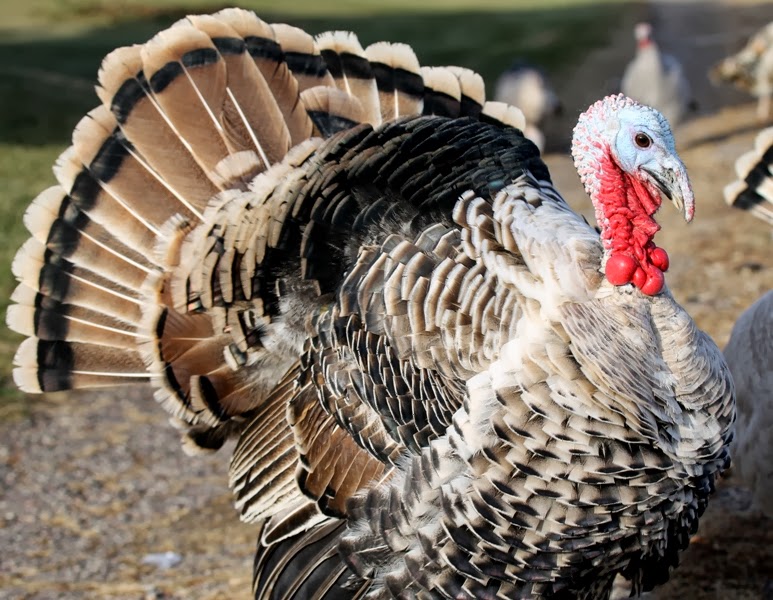
Sweetgrass turkey at Litengård

For in Truth the Turkey is in Comparison [to the bald eagle] a much more respectable Bird, and withal a true original Native of America... He is besides, though a little vain & silly, a Bird of Courage, and would not hesitate to attack a Grenadier of the British Guards who should presume to invade his Farm Yard with a red Coat on. ~ Benjamin Franklin

I never tire of watching our turkeys.  We raised 28 this year - 5 commercial broad-breasted whites and 23 heritage - a variety of breeds including Blue Slate, Jersey Buff, Tiger Bronze, Chocolate Pencilled Palm and the above pictured Sweetgrass.

these Jennys are "on the fence" about celebrating Thanksgiving

These intensely curious birds are endlessly fascinated by the buttons and rivets on my farm pants and even remember which pocket I keep my gardening gloves in.  Sneaking a glove out of my leg pocket is a favorite game, which always leads to a game of keep-away.

It is impossible to be sad in the turkey paddock, and I have often escaped from the stresses of my modern world with a visit to their primitive one.  They are by far the most beautiful and engaging birds on the farm.

Sweetgrass hen checks out the rabbit tractors

And although it saddened me greatly when we took 14 of our flock to the processor to grace the tables of several of our family and friends this year, my heart is gladdened by the thought that the turkeys upon those tables lived as good a life as any turkey could ever expect to live - safe from predators, with fresh clean air and sunshine every day, on green grass, chasing crickets and moths and my yellow gardening gloves across the paddock.

Sweetgrass turkey tail feathers

Today I will once again sit in the presence of my little flock, listening to their chirrups like overgrown tree frogs, and be grateful for all of the wonderful blessings in my life.

Oh, and my flock wanted me to share this joke with you:

Why did the turkeys cross the road?

Flock of turkeys at Litengård farm

To prove they weren't chicken!

Cheers -
www.GypsyFarmgirl.com

Wednesday, November 27, 2013

Jenny the Silkie-Ameraucana chicken who thinks she's a turkey

This is Jenny.  We hatched her out of a bantam blue egg laid by our bantam Ameraucana Jazzmine. Apparently her papa was Poppy the black Silkie.

So she has real chicken feathers like her mama (unlike Silkie feathers which are more like fluff) but black colored like her papa, extra toes like her papa, black skin like her papa, feathers on her feet like her papa, and lays bantam blue eggs like her mama.

She grew up with our Sweetgrass turkey flock and has only been with turkeys her entire life.

So we named her "Jenny," since a Jenny is a female turkey hen, and she thinks she's a turkey.

Cheers -
Gypsy Farmgirl writes about Jenny the Silkie-Ameraucana chicken

Sunday, November 17, 2013

Dragon carrots harvested from the gardens at Litengård

My gardens since moving to the Little Farm have been perpetually behind.  Slow to get planted, slow to get weeded, slow to get harvested.

gorgeous colors inside and out on these Dragon carrots from Seed Savers Exchange

Despite this fact, I still seem to get a lot of things harvested out of it.

Like these gorgeous Dragon carrots, dug out on November 17.

Out of the mud.

Yum.

Cheers -
Gypsy Farmgirl harvests Dragon carrots

Wednesday, October 9, 2013

close-up 5-day old New Zealand White rabbit
awwww
The kits that were born last Friday no longer look like tiny piglets - naked and wrinkled.

They've grown and filled out the wrinkles, along with sprouting a fine coat of white fur.

They now look almost rabbit-like.

5-day old New Zealand White bunny

If you are already familiar with our rabbit pens, which have slatted floors and are moved across the pasture twice/day, you're probably wondering, "How will they keep the babies in the pen?  Won't they fall through the slats?"

Well, in fact, yes, they would.  Once the babies start venturing outside the nest box we will indeed have to "baby proof" the pen.  To keep them from falling through.

cutie little bunny face
whiskers!
I had a mishap yesterday actually, when one of the sides came apart from the nest box and a baby wiggled out of the box and fell onto the grass below the pen. I found it and placed it back into the nest box.  It seems perfectly fine today.  And fixing the nest box is now our top priority this weekend. 

But for the next few days at least, Mama will still have unrestricted access to the pasture. 

And babies will remain in a pile, safely in the nest box.

5-day old New Zealand White rabbits

Cheers -

Tuesday, October 8, 2013

4-day old New Zealand White rabbits

I just can't get enough of these babies.

Would you look at those ears.

baby new zealand white bunny ears

Those noses!
 
baby New Zealand White rabbit

The whiskers!

sleepin' in a pile - baby New Zealand Whites

And toeses!

itty bitty baby bunnies

Cheers -
Dr. Seuss

aka:

Friday, October 4, 2013

Athena peeks out of her nestbox with a pink newborn bunny

Leave it to the rabbits to throw our day out of whack.

It was all so neatly scheduled. 

For the first breeding, Atlas our New Zealand White buck (male) bred Astarte on Tues. and Athena on Wed.  A week later we tested them both to see if the does "took" the first time. 

Astarte CLEARLY was not interested in a rebreed - hopping out of the rabbit tractor entirely in an effort to get away from Atlas.

Athena however was a little less convincing and in fact allowed Atlas to breed her, convincing me that her first "date" wasn't successful.

We started the countdown. 

27 days from the first breeding date Astarte's nest box would go into her mobile pen. 

On day 26, Astarte started nesting activity (pulling belly hair out to line the nest box).  I picked it up off the ground after I moved her pen and went to get her nest box.

(Their mobile pens have slats in the floor so they can graze pasture between the slats, and their pee/poo falls onto the pasture.  As does a pile of white belly fur.)

I also brought out some hay and put a handful along with her fur into the nest box. After munching on some hay, she jumped into the nest box to "decorate."

27 days from the second breeding date, Athena's next box would go in. She did not begin nesting on Day 26, or Day 27 or Day 28, 29 or 30.  So I assumed my calculations were correct and she would be due the following week.  But just to be safe, I put in an old nest box (which Papa Bear was going to replace over the weekend with a brand new one) on Day 30, along with some hay.

Then came day 31 post breeding #1.  Eager to see if Astarte would deliver, I checked inside the nest box during my morning rounds.  Nothing.

Later that day, just as I was wrapping up a work call, PB came into the office and said "I was going to swap out Athena's nest box for the new one but there are babies in her nest box."

Wha???

He continued "Oh, and Astarted delivered, too.  Two sets of babies just born."

Oh. My. Goodness.

Needless to say we forgot about heading into La Crosse for the farmer's market that afternoon. We were busy counting heads (five in Athena's litter - her first - and seven eight in Astarte's litter - her second) and snapping photos.  

newborn new zealand white bunnies

Newborn bunnies look nothing like rabbits.  If you had showed me this picture and I had not known what the white fur was, I'd have assumed these were piglets.

Eventually we got all the evening chores done and we did go into town to celebrate our 11th anniversary.

Happy Anniversary Hunny. 

May we be as prosperous in life as our rabbits.

(But perhaps not quite as prolific).

Cheers -


Monday, September 30, 2013

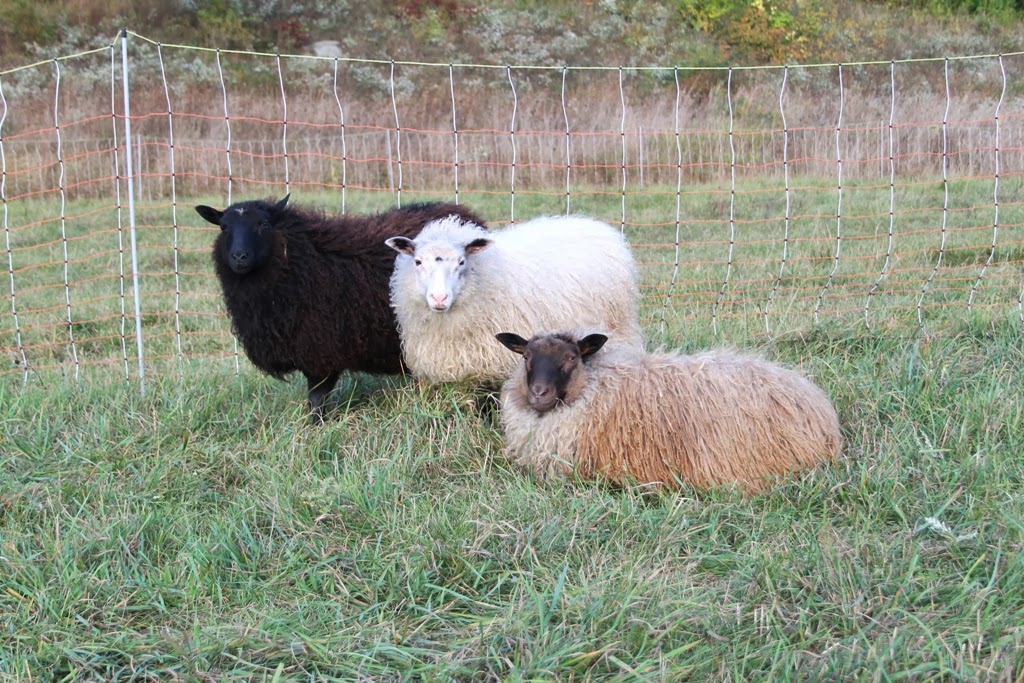
Litengård welcomes three new Icelandic ewes!

At long last, the start of our permanent ewe flock has begun, the arrival three beautiful Icelandic ewe lambs from Whippoorwill Farm in Iron River, WI.

Until now I've only been dreaming of starting our own ewe flock and practicing sheep care with our Amish market lambs

Last year this entailed trimming hooves, treating hoof rot, trimming hooves, treating diarrhea, trimming hooves, treating pink eye, and trimming hooves.

This season we've had nary a problem with our ram lambs except that they are now getting a bit "rammy" and I have to watch my knees when I'm in their paddock.

{They weren't supposed to get rammy this year... they're all... well... wethers...}

Icelandic ewes of Litengård farm

Last winter once the sheep were all gone I spent a fair amount of time researching a variety of sheep breeds, trying to narrow down my "top 10" list to maybe just one or two breeds.

I soon realized most of my favorite breeds had some attributes in common - such as they all tended to be northern European "primitive" breeds, which are basically a breed, usually ancient, that has not been much "improved" by changing the breed to accommodate better meat or wool production. They remain more like they were thousands of years ago. They also all tended to be "landrace" breeds and they all tended to be "short-tailed."

The benefits of these attributes are many - they have survived for thousands of years, usually with minimal management interventions.  The ones that were prone to problems and parasites have died off or been culled.  They tend to be easy-birthers and great mothers.  Their natually short tails mean no tail docking is required, and because of this, ewes will not tend to prolapse (a problem in docked-tail sheep).

"Which way is home?"

In short, they tend to be hardy.  And let me tell you, after spending every weekend treating hoof rot and diarrhea last summer in our mixed-breed meat sheep, having something a little more "hands off" was enticing.

Not only that, but we live in the northern Midwest.  Winters, although seemingly more often peppered with milder days, still tend to be severe.

We don't have a lot of barn space. The critters that overwinter here must have minimal housing needs.  Our alpacas will lounge outside in temps far, far below zero as long as it's not raining.  The sheep must be similarly inclined.

So after deciding I really wanted a northern European, landrace short-tailed sheep, I first settled on the Norwegian Spelsau, but upon investigation discovered they've never been imported into the USA.

{rats}

 However, there are some other closely related breeds that are currently in the USA.

Such as the Icelandic breed.  Not only do the Icelandics meet all of the above attributes, they do so with beautifully, naturally colored fleeces which are dual-coated and grow so fast it is necessary to shear them twice a year.

Their dual coat, consisting of an outer, longer, Tog, is around 27 microns and is fabulous for weaving and rug making and felting. 

The inner coat, the Thel, is shorter and finer, around 20 microns, perfect for making things for "next-to-skin" wear.

The beauty of all of this is that my new wool combs will separate these two coats so that I may use them for separate projects or leave them combined.  When spun together with a light twist a spinner can make a lofty "lopi" yarn.

{say it with me - Lofty Lopi Lofty Lopi Lofty Lopi...}

So the only question that remained was where to purchase our ewes.  After negotiating with a local farm for almost a year and having them back out on us twice, I noticed a posting on Facebook that my first choice farm had decided which ewe lambs they would have available for sale and were taking deposits.

Additionally, their farm was only 40 minutes from Washburn, where we were heading for a weekend of camping with our family.  It would be easy to pick the ewes up on our way home that weekend.

I thought we could just put them in the back of our Envoy but Papa Bear poo-poo'd that idea.  Something about our camping gear and twin-sized mattress taking up all the room.  So we borrowed an alpaca trailer and headed north.

I wish I had some pictures of Whippoorwill Farm.  Alas, I completely forgot my Canon Rebel at home that weekend. It was a lovely place, Scandinavian in style, with walking paths throughout the 15 wooded acres which served as laneways to move the sheep into sections of the woods where they did a darn good job of keeping the brush grazed.  The woods were dappled with sunshine and young tree trunks and grass, wide open and free of brush.

These sheep browse brush!  I no longer have to think about getting goats!

The girls were less than thrilled with being trailered, and even less thrilled about getting off the trailer in some strange field with alpacas and chickens milling nearby.  They wanted nothing to do with us, that's for sure. They hung closely to the fence nearest the Amish lambs for the first twenty-four hours.

But I've been working with them, enticing them with apple slices, and now Fönn, the white one, and Börk's daughter, the Moorit (brown one) will come up and look for treats.  Eva's daughter, the black one, wants nothing to do with me and wants to know when I am bringing her back to Whippoorwill.

"Whachu lookin' at, Willis?"

She'll come around.

Cheers -
www.GypsyFarmgirl.com


Follow Gypsy Farmgirl on Instagram Follow Gypsy Farmgirl on Twitter Follow Gypsy Farmgirl on Flikr Follow Gypsy Farmgirl on Pinterest