Sunday, March 30, 2014

Sweetgrass Tiger Bronze turkey cross

After sitting on my hands for 48 hours, I was finally able to open my incubator and remove my hatched turkey poults. You can clearly see the egg tooth on several of the poults below.

Wikipedia really needs some photos of something cute on that page like my turkeys our chickens, dontcha think?

Day-old turkey poults

The last few eggs to hatch are almost always weaker birds, and our hatch was no exception.  The last poult to hatch died.  The last two that hatched and survived were much smaller and weaker than the rest of the hatchlings.

One had a splayed leg/spraddle leg, which we fixed with a splint like they show in this post: Spraddle leg causes and treatments.

Turkey poults in their temporary brooder

I never got a decent photo of the little turkey, which we nicknamed "Blue" after the color of the Vetrap that we used for the splint.  He/she only wore it for two days and then its legs were perfectly straight so the tape came off.

Temporary observation brooder bin

After any hatch (chickens or turkeys) I always put them into a small, temporary brooder that I keep in my kitchen where I can observe them all for a day or two.  If someone is struggling, they stay here longer.

Turkey poult exploring the brooder

I make this brooder using a plastic bin minus the plastic cover, using chicken or rabbit wire for a mesh (breathable) top.  We added a brooder light without a big heat light bulb - instead we used a small 25 watt red bulb.  A red bulb is better for the babies when they are trying to sleep.

This small wattage doesn't generate enough heat, so we also added a heating pad underneath and a small electric heater near the brooder.  Temps should be between 95-100 F for new hatchlings.  It is advisable to set up this brooder several days before your hatch, as it will take some tweaking to get the temperature right.

After I'm assured everyone is doing fine, they all go into stock tank brooders in the basement.

Ingredients:
  • Wood stove pellets or other appropriate bedding that offers secure footing (nothing slippery like newspaper).  I find one bag per stock tank sufficient for a couple of weeks, depending on the number of birds in the space.  Pellets are SUPER absorbent, and smell good, too. 
Wood pellets make super absorbing bedding in brooders
  • Stock water tank (available at all farm supply stores).  The benefits of stock tanks for brooders are several.  They have curved ends, which prevents chicks/poults from piling up on top of each other. Square corners can cause massive pile-ups and suffocation. They won't leak. They're made to hold water, so no worries like you have with cardboard brooders getting soggy and leaking.  They are easy to clean out at the end of use. Especially polycarb tanks. Shovel out the pellets (add them to your compost pile) then spray them out with a hose.  Used galvanized stock tanks can usually be found second hand for cheap.  Ours was left here on the farm when we bought it. It might not hold water perfectly anymore, but the pellets in the bottom of the tank are super absorbent and if we were really worried, we could set it on a tarp or other piece of plastic. 
Stock tank brooders for turkeys or chickens
  • Brooder light fixture and heat light bulb (red) 250 watt. 
  • Thermometers (one for every tank)
Day-old poults and chicks need 95-100 F
  • Feeders - turkeys need a higher protein starter mix than chickens.  We get ours (organic) at our local feed mill.  It is 26% protein. At first we just use the feeder base, then as the poults eat more, add the top part that holds a quart of feed at a time.
  • Waterers - I do not like open waterers like the one pictured here. The chicks/poults inevitably soil it with bedding and poop.  Since we never put medication in our feed or water, I really don't want poo in the water trough. When the chicks are a bit older, they will readily drink from a rabbit/guinea pig hanging bottle, which keeps the water much, much cleaner.  But for babies, we are still looking for a better way to water that the turkey poults will easily catch onto. We do put a small amount of apple cider vinegar into the water to help control coccidia naturally.  
stock tank brooder

Again you want to set up the brooder several days in advance of putting birds in it so the pellets can warm up and you can make sure the temperature setting is correct.  To adjust the heat, raise or lower the heat lamp above the tank.

For every week of age, drop the temperature in the tank by five degrees until they are fully feathered and no longer in need of supplemental heat.  We will usually transition our birds into the Cheep Shed before putting them out on pasture for the season.  

heritage turkeys at Litengård

At a few days old we also start bringing chunks of sod (with dirt and grass) into the brooder for the chicks to play with. I've read the small amount of coccidia in the soil will help them gradually build up an immunity to it so there isn't a large hit to their system when they go out on pasture.  

So far, this system has been working well for us.  This is our second year hatching and our fourth year using stock tank brooders.  The only thing I would change is getting a few more tanks so I can have a lot more birds at the same time!

Cheers - 

Friday, March 28, 2014

Sweetgrass turkey egg beginning to hatch!

It all starts with a "pip," a small hole near the fat end of the egg, made by the poult's egg tooth.

{A poult is a baby turkey.  A chick is a baby chicken}

From there the chick will continue to break holes along a line around the end of the egg, called "zipping."

Sweetgrass heritage turkey egg "zipped"

Once the break line has circled the egg, the poult will then start pushing the pieces of the shell apart.

Sweetgrass heritage poult hatching!

The whole process can take a long time, sometimes more than 24 hours from the time you see a "pip" until completely hatched out.  Hatching is hard work!

This year I sat on my hands and resisted the urge to take the first hatchlings out of the incubator and put them into their temporary brooder.

Almost hatched!I read that opening the incubator even once during a hatch can completely halt the hatching process due to the severe changes in temperature and humidity that occur when the incubator is opened.  Pipped eggs are especially sensitive to any sudden changes in environment.  The loss of humidity can be enough to make the membrane dry out and the poult will die before it can complete the hatching process.

Turkey eggs normally incubate for 28 days, but mine tend to start pipping on day 24 and hatching on day 25.  The vast majority of my eggs hatched on day 26 this year.  When we woke up Friday (day 27) 25 had hatched so far and two more were in progress.

Resting before the last move

Final count: 30 eggs, 1 removed at 2 weeks (not fertile); out of 29 fertile eggs, 28 hatched, one died, one did not hatch.  We opened it and it was fully mature.  We'll never know why that one didn't hatch.

But we're ecstatic with 27 new heritage turkey poults!  If we had purchased that many online the expense would have been close to $400 with shipping.  And since we already have 40 turkeys sold for this coming Thanksgiving, 27 is a good start.  We'll still need to purchase a few to round out the order.

Made it! Hello world!

Next year I'm thinking two incubators... or maybe Papa Bear can make one big one for me.

Cheers -
Gypsy Farmgirl writes about hatching heritage turkey eggs


Wednesday, March 5, 2014

Gypsy with begging eyes

It's hard to believe I have been officially "retired" from my off-the-farm job for two months already. My image of my new, idyllic, carefree life full of long naps and long walks has not quite come to fruition.

Something about taxes needing prepped and fence lines needing brushed keep coming up as higher priorities.

{Mostly tax prep.}

Nevertheless, in between chores and taxes and fence lines I have been enjoying a new sense of time and space that comes from not being driven by anyone else's clock for the first time in over 25 years (longer if you count the schedule I had to keep while in school).

Gypsy waits

My treks to the back fence line (the farthest corner from the house) gives me ample opportunity to play with Gypsy.  She loves fetching things more than any other activity.  She loves chasing sticks so much that I had to train her not to chase after the brambles I tossed aside when I was cutting them off the fence line.

Gypsy waits for me to finish brushing the fenceline

Brushing the fence line is best done in winter I discovered, when I can wear all of my insulated barn clothing (protection from scratches) and can work hard without getting too hot.  No bugs, either.  Which is handy when you have to cut a thorny bush that has a wasp nest bigger than a basketball embedded in it.

Besides taxes and fence lines, we've been eagerly anticipating the end of the month when our turkeys will hatch.  We've loaded up our little Styrofoam incubator (the cheapest one the farm supply store carried) with our own Sweetgrass heritage turkey eggs.

Incubator with Sweetgrass heritage turkey eggs

I've been carefully turning them three times a day and monitoring the heat and humidity levels.  We've candled them twice and only removed one egg, so I'm crossing my fingers for a successful hatch

30 Sweetgrass turkey eggs incubating

And the lambs - well, the lambs are just fine.  Fat and sassy and happy.  Just waiting for spring, like the rest of us.

Baa baa black sheep...

Cheers -
Gypsy farmgirl writes about March happenings


Thursday, February 27, 2014

Such sweetness

I try to keep a good attitude, I really do, but lately this extended deep freeze and wind chills to the double digits below zero has been driving me cranky.

Elli whispers secrets to another sheep
"Psst: wanna hear a secret? Winter is never going to end!!"
Chores last eve got me so riled up I smashed my empty buckets and sled together just to keep from breaking something more valuable in my frustration.

Gypsy waits patiently for a game of fetch

And it's not even like there were things going wrong.

Granted, the sled always seems to tip over with full buckets of water now as I move over the frozen river of ice that used to be a driveway.

Papa Bear snuggles with Hunny, our Velveteen Lop rabbit

And I fell down on the ice while smashing aforementioned buckets together.

And I get awful tired of lugging buckets of water out of my bathtub, the outside water spigot having been frozen since early December.

Gypsy wonders when the next play session will be
really, who wouldn't smile at this face?
But it was more than that.

I've just plain had enough of this winter.  It's time to let up.  It's time to crack the lid on this chest freezer and give us some room to breathe again.

Little flock of sheep at the Little Farm

So to cheer myself up I'm posting some photos here of the things that still make me happy.

To highlight how much I still have to be grateful for, despite my weariness and crankiness and dwindling propane and frosty windows.

Jack Frost on my kitchen window

I hope they bring a smile to your face, too.

Cheers -

Gypsy Farmgirl is tired of this arctic winter


{P.S. - if you missed my post about adopting Gypsy, our border collie, feel free to read it here!}


Thursday, February 20, 2014

2-week old baby New Zealand White rabbit

If you are squeamish or reading this aloud to a young child, you might want to skip this post.

We have a fairly new litter of bunnies in our colony.  They were born on 2/4, right on schedule (31 days after the doe, Athena and buck, Atlas, had their, ahem, date).

When I checked the nest box during morning chores I found a small pile of dried off babies in the back of the nest box, and 4 more just born near the entrance.

I knew from reading a variety of resources that babies can get cold very quickly and die, and also that sometimes mamas have some in one place and some in another and they all need to be together to conserve heat.

Every resource I've read agreed - contrary to popular belief, you should move the babies if they are not together in one pile.  Mama will not abandon her nest, especially if she knows you and your scent already.  And this mama doe knows me - she is the tamest of the colony, following me around the barn begging to be pet.

I also knew that even though our barn stays above zero most days, the next box in the back corner of the barn was near a cement wall that had frost coming through the cracks in white blobs, and our temps at night were still sub-zero.  That corner of the barn would not be nearly as warm as the front.

So I moved the new pile of babies to the back of the box as carefully and quickly as I could.  Then I put the top back on the nest box and left it alone for the rest of the day.

I tend to only check babies once a day, as I hate to let cold into the nest box by opening the top and also don't want to stress the mama doe.  So the next morning after checking on the poultry, chickens, sheep and alpacas, I once again peeked into the nest box.

The pile of babies had decreased in number, and one was half eaten.

{i think i threw up in my mouth at this point}

Being the only one in the barn at the time, I had no choice but to remove the dead, mutilated baby myself.

{more throw up}

Over the course of the next several days, the remaining pile of babies dwindled to four. Although I never got a decent count on the first day, I estimated 7 or 8 babies where in the box the first day.

I did not find any more partially eaten remains, so I assumed mama had eaten the others entirely.

The last one to disappear did seem to me to be rather runtish, smaller and weaker than the rest.  Perhaps she knew she could only support a certain number and culled the weak ones herself.

Sometimes mother nature is violent and brutal.

If any of you reading this are aching to move out to a little farm of your own, envisioning yourself romping throught he wildflowers surrounded by puppies and kittens, where all the days are summertime-sunny and all the critters are always happy and healthy, stop the daydream.

Yes, there are days like that on the farm. That is what entices us to our own a piece of land.  That is what sustains us through the bad times.

But there is also the flip side.

The day you walk out to the paddock to find your favorite bantam Silkie chicken has drowned in the water bucket.

Or the day you move the rabbit pens and find one baby has slipped through the cracks and is dead in a patch of clover.

Or the day you walk out to the paddock to find your favorite fawn alpaca has tangled and wrapped himself so tightly in the portable net fence you're not sure if he is even alive. And three agonizing weeks later, he dies of his injuries.

Or the day you come home from Christmas vacation and on your first round of barn checks, find your favorite cria quietly cushed in the spot where she and her mama always rest together.  But her eyes don't see you anymore, and she is not breathing.  She is still warm.  She died as you were hauling your luggage to the house.

Of course there are more good days than bad, or none of us would survive all of the heartbreak.

But still, we must get through the bad days somehow.

And so with a heavy heart I lift the lifeless body - be it chicken or bunny or alpaca - and carry it away. And hope that there won't be another for a long, long time.

Yesterday was one of those heart-heavy days.

After my usual round of chores I checked the rabbit nest box on my way out of the barn. There had been four fat, happy babies the day before, just starting to open their eyes.

I checked the pile and found only three.

I searched the rest of the box, which is always packed tight with hay in the opening (by mama) so it seemed unlikely one had escaped.

There was a clump of rabbit fur between the entrance stuffed with hay and the pile of babies.  Mama does pull out their own belly fur right before she kindles (gives birth), in order to line the nest.  The pile of fur seemed heavy and matted together. I lifted it out of the box.  It was too heavy to be just fur and hay and it smelled putrid.

I didn't investigate further.  There was something dead in it.  I just took it from the barn and burned it in the burning barrel.

One more dead baby.

Why?

Did mama kill it?  Is it because now that they're eyes are opening we've starting holding them a little bit and that's stressing out the mama?  Is it because of the colony?  This is the first litter born in the colony.  Is she just a bad mama?  This is her second litter and we don't lose a single one of her first litter.  Am I just a bad caregiver?

All of these questions weighed heavily on my mind and heart, so I grabbed my snowshoes and pruner and machete and headed out to the back of the property to cut brambles.

Physical labor is always a welcome relief when the mind and heart are heavy.  The tougher the task, the better at taking my mind off of dwelling on unanswerable questions.

Gypsy accompanied me of course, eagerly waiting for me to set down my tools and throw her stick for the millionth time. And whenever I paused to do this, I had to smile and laugh watching her bound through the deep snow and pounce on the stick whenever she found it. I've never known a dog to smile as much as she does.  Or have as much energy.  Or want to play such endless games of fetch.

When I returned to the house an hour and a half later, I was physically and mentally tired and that felt good.

New Zealand White doe

This morning I enter the barn with trepidation.  I do all of my chores - open the pop-hole for the turkeys and chickens, check the nest boxes for eggs (finding three turkeys and one chicken all sharing the dog kennel I use for the turkey nest box) top off the feeders.  I feed the rabbits, top their water, check the babies in the nest box.

Three fat babies are still in there, thank goodness.

I am about to head out of the barn for the last time when something tiny and white catches my eye.

It is a baby rabbit hopping across the barn.

Now that their eyes are open apparently one made it past the packed hay in the end of the nest box.  I assume it is one of the three remaining so I catch it and put it back in the nest box.

To my surprise, there are still three in there!  This is number four!  It must have gotten out yesterday and escaped my notice during both morning and evening chores.

Hooray!

Which means the pile of fur and rot that I took out the day before had been from the week they were disappearing, not from yesterday.

So, Athena did not kill her 2-week old baby.

And I did not kill her baby by holding it.

She is still a good mama.

And I am still a good caregiver.

There will be more losses in the future, of that I am sure.

But today, I give thanks for one tiny baby bunny hopping through the barn.

Cheers -
Gypsy Farmgirl heartache and happiness

Saturday, February 1, 2014

Happy New Year!

It's that time again.  Well actually, it's past that time again, time for the holiday family photo and letter. I'm begging off being so late this year due to a) we weren't with our daughter until Christmas Day, making a pre-Christmas photo card pretty impossible; and b) right after Christmas we left on two holidays. I'm home now, so no more excuses.

Let's start at the beginning.  I know I have missed a lot of posts this year, and I am aiming to try to catch up and fill the gaping holes by posting backwards in time (kind of like Dr. Who, but without a Tardis). But until I get everything posted, here's an outline of what kept us busy this year. 

It all started with the Winter that Refused to End.  The critters seemed to stay toasty enough inside the Cheep Shed.

Boo & Monet looking for summer

Hens roosting in the Cheep Shed

Hunny, our Velveteen Lop, tried to kick-start our kitchen remodeling project by chewing up the old linoleum. She went out to live in the barn when we ran out of bricks to put on top of the numerous chewed areas.


A visit to our friends at Nordic Hills in early Feb. brought us joy watching their new baby lambs romping about.
 
Lambs in the barn at Nordic Hills

What better way to endure the Winter That Refused to End but bottle up some home-brewed pear cider (perry) from our very own pear tree? 

{Note: it was nom!  Perfect with a bowl of popcorn and a movie on a cold night}

Bottles ready for perry cider

The end of March brought yet more snow but also our first attempt at tapping our tiny maple stand (4 whole trees).  Then one of our four trees blew down in a bad wind in late spring.  But before that happened, we managed to salvage 8 gallons of sap which turned into a couple pints of syrup.

Tapping maple trees

{Tip: Don't boil down 8 gallons of sap in your kitchen.  You'll have a maple-scented house for ages (not a bad thing) but that much moisture in a small area will wreak havoc.  We had varnish-maple-sludge hanging off the cabinets and dripping down the walls.  Not good.  Boil it up outside.}

boiling down maple sap into syrup

In April the cats started venturing outside on a more regular basis.  They found the wood pile to be a nice vantage point to scan the hay fields for rodents or scary-things-that-might-be-approaching.

Zoey & Mojo on the wood pile

Early April brought an ice and wind storm that took down several large branches from the white pines near the house, and also the aforementioned maple tree.

April ice storm

But April also heralded the arrival of our very first turkey hatchlings, their gangly legs and tiny peeping lifting my late-winter-waiting-for-spring spirits. 

newly hatched Blue Slate turkey poult

We also welcomed a hatch of 11 of our own chickens, 10 of which turned out to be roosters!

Ameraucana cross chicks

Work took me away from the farm for the last two weeks in April, a change I welcomed, even though I only got as far south as Danville, IL.  Still, there was no snow, temps were mild, and I got to wander through Heron County Park and Wetland area several times over the two weeks I was in the area.

Trumpeter Swans in Heron County Park, Danville, IL

Highlights included a Blue Heron rookery, eagles, geese and swans and many other water-loving birds.

Mother's Day found a rare, spare minute with C-baby at the MN Landscape Arboretum. The hothouse orchids and flowering trees reminded us that spring was indeed just around the corner now.

C-baby at the MN Landscape Arboretum

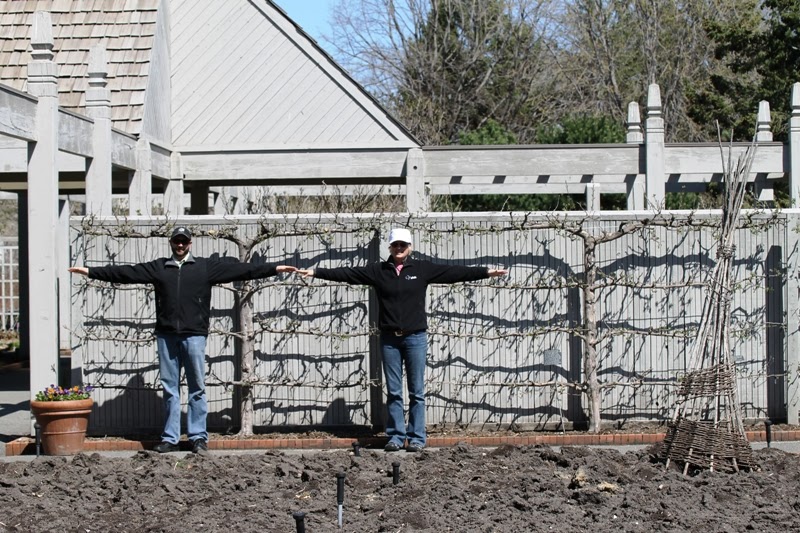
espaliered at the MN Landscape Arboretum

May 15th brought one of my very favorite days of the entire year - the arrival of our Cornish Cross Broiler chicks from Cackle Hatchery!


Plus a small handful of Broad Breasted White turkeys, a commercial breed (your typical Butterball turkey), which we thought we would try raising on pasture this year along with our heritage turkeys.  BBW's have been raised for generations to grow very fast and put on a lot of breast meat.  We hoped they would also thrive on our pastures like our meat chickens have been.

Broad-breasted white turkey poults

{They did!  Our hens were 26# and our toms 36# at harvest!}

Two days after the broilers arrived we picked up our order of 200 saplings - maples, domestic apple, plum, cherry, walnut, spruce, elderberry, and serviceberry - and began the task of planting.  This tedious task was greatly aided by the purchase of a bulb drill, and Papa Bear seemed to enjoy using his new gadget to drill all of the planting holes.  

I'm hoping we have a crew living here by the time these trees have their first (and subsequent) harvests!

Papa Bear showing off the bulb drill, used for sapling holes

Mowing around all of these trees all summer long would prove to be one of the most time-consuming tasks on the farm every weekend.  Thank goodness for the riding lawn mower!

mowing for the spruce tree windblock

{Thanks mom & dad!}

As if mid-May wasn't busy enough already, we also had to squeeze in alpaca shearing. Shearing alpacas is fun, if your version of "fun" includes full body wrestling, dodging spit and cleaning up piddle & poo.


{And if your version of fun DOES include the above, please come over when we shear in the spring!}

Monet's gorgeous fleece coming off

My naked girls, Brigid (back) and Grace (front).

naked alpacas!

Last year there was new grass growing in March and temps in the 70's.  This year we had to wait until mid-May to put anyone out on pasture.  But oh what a beautiful time of year it is on our little farm!

spring on the little farm!

Bleeding hearts at the Little Farm

Last year we spent most of June running back and forth to our multiple storage units in Mayer retrieving our belongings one, 16' flatbed trailer load at a time.  Needless to say, there was no time to put in a garden, which happily ran rampant with weeds galore.

This year however I was determined to tame the dragon.  The entire, 26'x110' dragon.

I started by weeding the two rows of garlic I hastily put in late fall.  This task alone took me about two weeks of back-breaking labor.  Thankfully our friends took pity on us and one day dropped off their rototiller.  Now I'm a fan of doing whatever I can without a machine.  We own no tractor, no skid steer, no equipment larger than a lawn mower and old ATV.

However, I could have cried when that rototiller showed up unexpectedly.  In a couple of hours the entire garden was done.  After which we put the chickens on it, to scratch up anything else they could find (pests!) and give it a little nitrogen boost.

chickens in the garden

Alas my lofty garden plans fell by the wayside when animal chores and work tasks took priority of my time.  I did however manage to get a small plot of Indian corn planted (which was supposed to be a plot of 3 sisters) along with about 16 tomato plants, a packet of Dragon carrots and over 500 Black Valentine black bean plants, which did supremely well despite my neglect, 1/3# of seeds yielding over 8# of black beans at harvest.

The rains that came in May didn't let up until the very end of June, which meant no making hay until the beginning of July, which meant the critters could not go out to graze on the hayfields until after the 4th of July.  We did graze the alpacas around the orchard, carefully avoiding each row of baby trees.

Alpacas grazing in the orchard

The end of May brought my favorite delivery of all - even more precious than the baby broiler chicks - the arrival of 17 heritage turkey poults from Porters Turkeys.

I hadn't realized heritage baby turkeys were such a hot commodity.  I wanted to receive my poults in April, but they had already sold out until July, unless I was willing to take a "grab bag" of leftovers from their earlier hatches. So I ordered the minimum - 15 birds - and hoped we'd get some breeds we liked.

What we ended up with were 17 bundles of peeping adorableness.  6 Sweetgrass (a breathtakingly gorgeous breed which we've kept for our permanent breeding flock); 4 Tiger bronze (we kept 2 females); 3 Pencilled Palm and 4 Jersey Buff.

Heritage turkey poults from Porters Turkeys

I had forgotten how crazy busy May was until looking back at everything we crammed into this month. Especially given Papa Bear is only around 3 days/week to work on farm stuff with me.  And I was also going through a massive certification program for my job, which required at least 20 hours/week just to study for each of the 22, 2-hour tests I needed to pass to complete my certification.  How we survived May I still don't know.

The broilers all went out on pasture between 2-3 weeks of age, where they will spend their remaining six weeks chasing bugs, eating grass and of course getting big.

broiler meat chickens on pasture

This year I left the door to the pen open so the chickens could wander more of the paddock, although they rarely went more than a few feet from their large feeders!  I still moved their pens every day, since the manure builds up wherever the pen is (wherever they rest).  And despite a pair of Red-tailed Hawks on the property, we've not lost a single bird (or any critter) inside our electric fences from Premiere1 and Kencove.

Everything on our farm runs on grass.  From the broiler meat chickens to the heritage turkeys to the rabbits, we (or rather, Papa Bear) has devised mobile pens that we move around the fields surrounded by protective electric nets (solar powered), moving the animals as their supply of fresh grass runs low.

This does several things - it breaks the parasite cycle, it gives the pasture grasses enough rest (grazing too soon is the fastest way to kill off your pasture), and it forces the animals to eat everything in the pasture - not just the "candy" (clover, alfalfa).  They have to eat their vegetables, too.  It promotes a "polyculture," and that is exactly what we want in our pastures.

Due to the heavy rains during May and June, our order of honeybees was delayed until the end of June.  We installed a nucleus colony into each of our two new top bar beehives and crossed our fingers we could keep them alive all summer.

Nucleus colony box sitting on top of top bar beehives

Using this type of hive does not produce the biggest harvests of honey, but we were more concerned with the ability of the honeybees to build combs to their own specifications (which helps them reduce the population of varroa mites which kill thousands of colonies every year) and having them around to help pollinate our own gardens.

installing nucleus colony frames into top bar hive

The bees were pretty active the day we installed them, but thankfully nobody got stung in the process.

A small group of Amish market lambs arrived the end of June, thanks to our cobbled-together "redneck livestock trailer," i.e., cattle panels and some tie-down straps.  Unlike last summer, this year we never had to trim a hoof or treat for foot rot, weepy eyes or the runs.  These lambs were vigorous and healthy.

redneck stock trailer

Lambs in the haybunk.

lamb in the haybunk at the Little Farm

July saw the arrival of Grace's first cria, a black female we named Bella Noche. Despite their giraffe-like gangly legs, these little critters are usually up and walking around within a couple of hours.

Grace's first cria, Bella Noche

This month we also moved the baby turkeys into the cheep shed (out of their stock tank brooders).  Turkeys are more fragile than chickens and require a longer period of time out of the elements.  Here a pair of pint-sized toms strut their stuff.

baby tom turkeys (jakes) strutting in the Cheep Shed

Our hay was finally cut and baled the beginning of July, which meant spending the entire 4-day holiday weekend picking up bales and stack the haymow.

Blue Slate tom turkeys discussing the hay crop

Our haymow holds about 500 small square bales.

full haymow

Our first New Zealand White meat rabbits arrived and went out on pasture in mobile pens Papa Bear created.  Rabbits eat a lot of grass when given the chance.  This makes them healthier and happier than rabbits fed pellets alone.

New Zealand White rabbits on pasture in mobile rabbit tractors

At 8 weeks of age, I piled all 48 of our broiler chickens in the back of the Envoy SUV, cranked the A/C and headed 100 miles to the nearest USDA processor. They all dressed out around 4#, a perfect roasting size.

7-week old Jumbo Cross broiler chicken on pasture

In late July we snuck in a quick camping trip with extended family to Whiteface Reservoir in northern MN.  Here Papa Bear creates a s'more that to me looks like a pig snout!

s'mores are the best when camping

The end of July Brigid had a dark brown male we named Cocoapelli - cocoa for his color, and the rest a play on words for the trixster character of the southwest.

Brigid's Cocoapelli

I also began learning how to spin this month.  Some of the women in my knitting group also spin, so I asked one of them to teach me how.  She has a Louet wheel that even a novice can learn to spin on.

learning how to spin

My first skeins of spun yarn.  First attempt is the ivory one in the middle. The grey one on the left was my second attempt.

Handspun wool yarns

By August we had mostly settled into a routine.  Move the sheep and alpaca paddocks twice a week.  Move the turkey paddock once a week.  Move the rabbit paddock every few days (and the pens twice a day). Haul 8 x 4 gallon buckets of water (over 250# of water) daily to the various paddocks (via ATV and cart).  Haul 50# bags of feed to the poultry paddocks every few days.  Try not to melt in the summer heat.

Boo watches me while Monet relaxes

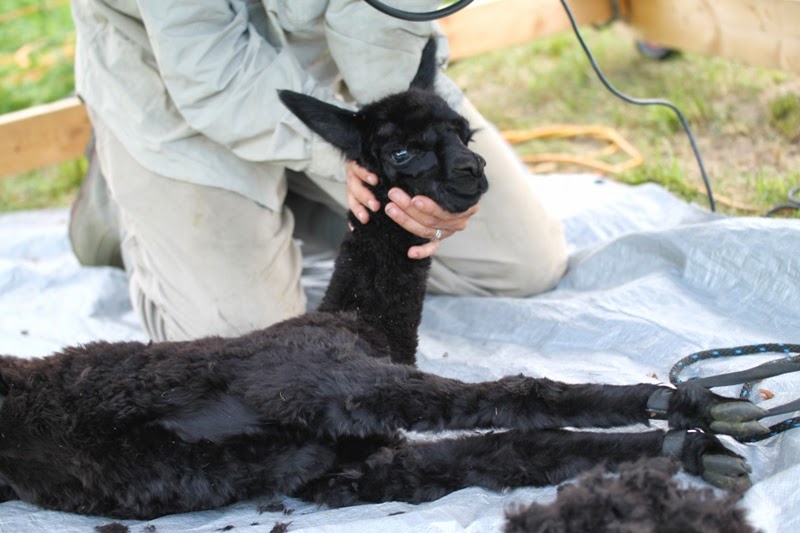
After Cocoapelli was born, we waited a couple weeks then sheared both crias. Doing so helps their coats grow in better by removing the "cria tips" that were present en utero and which get very brittle and also cling to all sorts of vegetable matter.  A sheared cria will have a much nicer first clip.

Bella Noche gets shorn

We also picked up a few more rabbits this month, when a friend was leaving the area and had to find homes for his two does, one of which came with a litter of black and white kits.  They too went out on pasture of course.

adopted baby bunnies

Mid-August was time to harvest garlic.  I can't wait to use our very own garlic all winter long.

garlic harvest!

Our commercial turkeys grew exceptionally well on pasture this year, our tom topping out at 36# and our hens around 26#.  Granted we were a month late getting them to the processor.  We have learned our lesson and will plan our processing dates more carefully in 2014.

broad breasted white turkey getting ready to be weighed

Late August found us out in Sheridan, WY for the Elk's Youth Rodeo. I really enjoyed watching all of the events and admiring the skills these kids have, many of whom have been on horses since they were toddlers.

Ribbon race at Sheridan Elk's Youth Rodeo 2013

By fall I am ready for things to start winding down. The physical labor of the summer is starting to wear on me, as well as the heat.

Papa Bear devised these ingenious mobile shade shelters for the ruminants this year, and they worked splendidly.  We're able to hang their mineral buckets inside to keep the minerals from getting wet, and the critters use them throughout the hottest parts of the day.

shade shelter out on pasture

At the end of September, on our annual trek to the Bayfield, WI area, we officially began our permanent breeding flock of ewes when we purchased three purebred Icelandic ewes from Whippoorwill Farm in Iron River, WI.

Icelandics were the only dairy animal in Iceland before large haying equipment became available in the 40's.  In addition to being used for dairy, Icelandics have a dual-coated wool (the Tog is the outer, courser and the Þel is the inner, finer wool)  that can be used for many purposes, and they are also a meat breed of sheep.  They are naturally short-tailed (requires no docking) and are excellent foragers.

Icelandic ewes Elli, Finn and Berrit

In October we finally had our very own first litter of rabbits.  They were left in the mobile pens on pasture, being careful to make sure they were in the nest box before moving the pen each time. We found kits raised this way are extremely vigorous and healthy, as the babies will nibble on grasses even while still nursing, slowly acclimating themselves to life on pasture and giving themselves the health benefits of different greens in their diets.  Conversely, kits suddenly exposed to pasture at an older age will often get diarrhea and die.

5-day old New Zealand White kit

In mid-October we were invited to bring some animals into Kendall for their annual fall festival, Colors of Kendall. Once again we utilized our redneck stock trailer for the transport.

redneck stock trailer strikes again

The festival visitors really seemed to enjoy the animals.  We also brought down some of our rabbits for kids to have something to touch.  My spinning instructor Pat was there with her Louet giving a demonstration.

Pat demonstrating how to spin at the Colors of Kendall

The next day, we sheared all of our Icelandic ewes.  They grow wool so quickly they actually need shearing twice a year.  We've shorn and assisted shearing hundreds of alpacas in our time on various farms, but these little ladies put up quite a fight for us.  We were all pretty worn out at the end of the day!

shorn Icelandic ewes

White, grey and black Icelandic wool.

baa baa black sheep have you any wool?

October was also when we finally got around to pressing all the pears we had harvested earlier.  The device Papa Bear is using can be made from these instructions here.

pressing pears


pear juice!

All of our Broad-breasted whites and a fair number of our heritage turkeys all went to customers for the holidays.  We kept our 6 Sweetgrass turkeys for a permanent breeding flock.  We already have orders for 40 more turkeys in 2014.  Looks like we'll be in the turkey business for awhile!

6-month old Sweetgrass tom

While researching meat rabbits I had read about raising them in "colonies," rather than individual cages.  So in one section of the cheep shed we set it up this way and allowed our two mama does and four female offspring to remain together, running around loose.  They are separated from the poultry.  The cement floors keep them from digging out. They really seem to be enjoying the freedom of this arrangement, and can often be seen running and kicking up their heels.

boys will be boys

Snow and cold came extremely early this year, plunging us into temps well below zero in early December.  I am grateful for our large crop of hay which should have no trouble getting us through the exceptionally cold season.

Happy 2014!

And that, my friends, concludes our year at a glance for 2013.  Thank you for visiting my blog, and please do come for a farm visit soon!

And if you're in the market for any of our grass-fed meats, please visit our websites:  Litengård (our farm site, still under construction) and Meadowfed Meats, LLC (our CSA meat share service). 

Cheers -
Gypsy Farmgirl blog

 
Follow Gypsy Farmgirl on Instagram Follow Gypsy Farmgirl on Twitter Follow Gypsy Farmgirl on Flikr Follow Gypsy Farmgirl on Pinterest